Skip to content

Revise by topic

Upper limb & breast for MRCS Part A

Upper limb and breast anatomy is the regional anatomy of the shoulder girdle, axilla, arm, forearm and hand, with the breast and its axillary lymphatics grouped here because they share the axilla. Applied surgical anatomy is 75 of the 180 Paper 1 questions; upper limb and breast contribute 8 of them. The brachial plexus is the spine of the domain — roots, trunks, divisions, cords and branches, and the deficit each lesion produces — followed by the course and relations of the axillary, radial, median and ulnar nerves, the cubital fossa, the compartments of the forearm, the carpal tunnel and Guyon’s canal, and the arterial supply from the subclavian artery to the palmar arches. Breast questions turn on the levels of the axillary nodes, the nerves at risk in axillary surgery and the lymphatic drainage. Most stems describe an injury, a surgical approach or an examination finding and ask which structure explains it.

80 questions in the bank · 1 topics Updated 6 October 2026

Topics in this domain

  • Upper limb & breast anatomy80

What the paper tends to test

  • Questions typically give a fracture or a surgical step and ask which nerve is at risk — the axillary nerve at the surgical neck of the humerus, the radial nerve in the spiral groove, the ulnar nerve behind the medial epicondyle.
  • Brachial plexus questions usually describe a deficit — a waiter’s tip posture, a claw hand, loss of shoulder abduction — and ask for the level of the lesion.
  • Expect the median and ulnar nerves to be tested through the motor and sensory signs that separate a wrist-level from an elbow-level lesion.
  • Carpal tunnel questions test the boundaries and contents of the tunnel and why sensation over the thenar eminence is spared.
  • Axillary questions ask about the long thoracic and thoracodorsal nerves, the intercostobrachial nerve and the levels of the axillary nodes relative to pectoralis minor.
  • Arterial questions tend to test the anastomoses around the scapula and the elbow, and the superficial and deep palmar arches.
  • Dermatomes and myotomes of the upper limb are examined through a cervical root lesion or a cervical disc prolapse.

Classic traps and discriminators

  • A high (elbow) median nerve lesion gives the ‘hand of benediction’ on attempting to make a fist; a low (wrist) ulnar nerve lesion gives the more marked claw hand. The ulnar paradox is that a higher ulnar lesion claws less, because flexor digitorum profundus to the ring and little fingers is lost as well.
  • The palmar cutaneous branch of the median nerve arises proximal to the carpal tunnel and passes superficial to the flexor retinaculum, so sensation over the thenar eminence is preserved in carpal tunnel syndrome and lost in a laceration at the wrist.
  • Erb’s palsy (C5–C6) gives the waiter’s tip posture — adducted, internally rotated shoulder, extended elbow, pronated forearm; Klumpke’s palsy (C8–T1) gives a claw hand and may include Horner’s syndrome from involvement of the T1 sympathetic fibres.
  • A mid-shaft humeral fracture injures the radial nerve in the spiral groove: wrist and finger drop with sensory loss over the dorsal first web space, but elbow extension is largely preserved because the branches to triceps arise proximally.
  • Injury to the long thoracic nerve paralyses serratus anterior and gives medial winging of the scapula that worsens on pushing against a wall; injury to the spinal accessory nerve paralyses trapezius and gives lateral winging with a dropped shoulder.
  • Level I axillary nodes lie lateral to pectoralis minor, level II behind it and level III medial to it; around three-quarters of the breast’s lymph drains to the axilla and most of the rest to the internal mammary (parasternal) nodes, which is why medial tumours can spread to the mediastinum.

Free upper limb & breast practice question

From the free sample — original, referenced, with the full explanation. Rate your confidence first.

medium

A 45-year-old man has anterior shoulder pain after a fall. He cannot lift the dorsum of the hand away from the lumbar spine when the arm is placed behind the back, and passive external rotation of the shoulder is increased compared with the other side.

Which structure is most likely injured?

How sure are you?
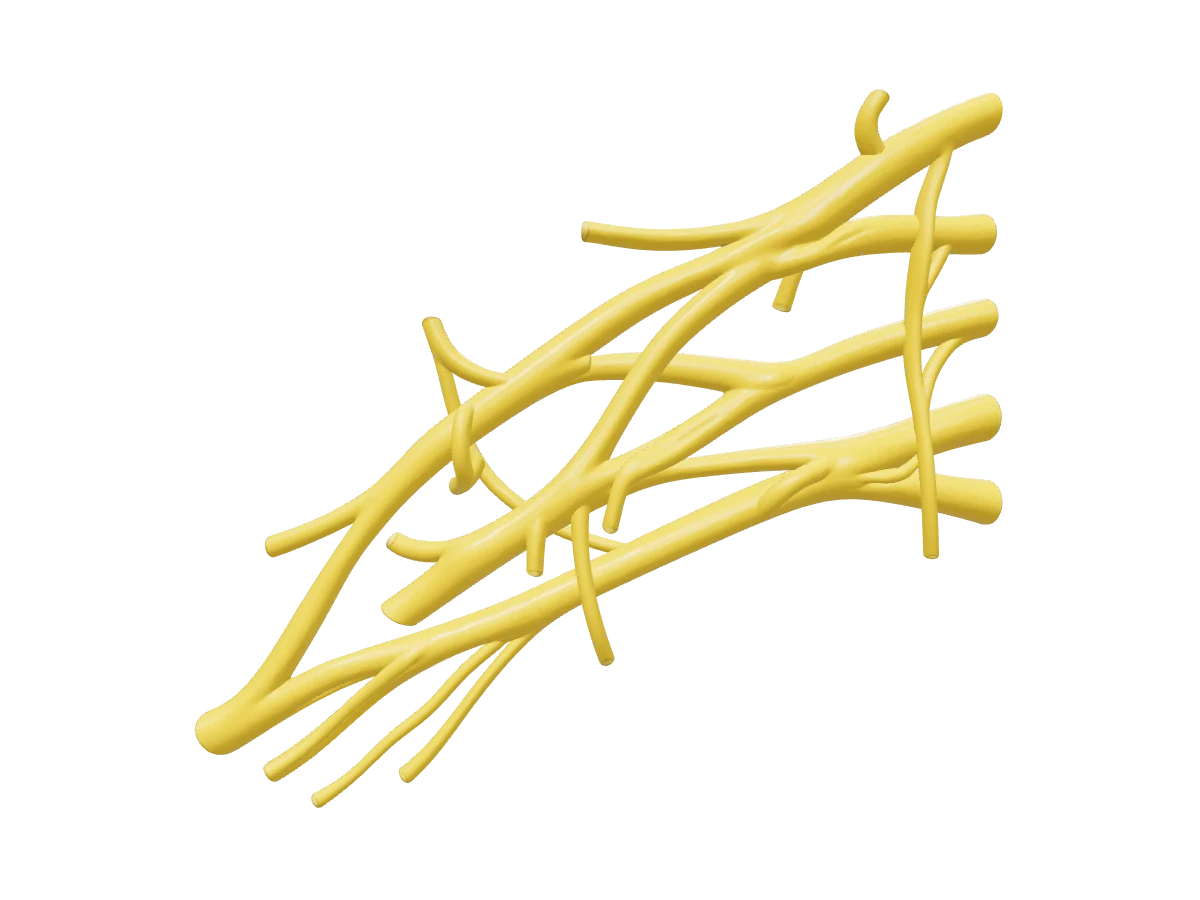
Interactive 3D: Brachial plexus

Drag to rotate, tap the hotspots, press play.

Brachial plexus — still render

Also in this domain: Shoulder & rotator cuff, Humerus & radial nerve, Hand & wrist skeleton, Flexor tendon sheath & pulleys, Wrist cross-section, Cubital fossa (coming soon), Axilla & breast lymphatics (coming soon)

Free revision notes

Upper limb & breast questions, answered

Which nerve is injured in a fracture of the surgical neck of the humerus?

The axillary nerve, with the posterior circumflex humeral artery. It gives deltoid weakness — loss of abduction beyond the first 15° or so — and numbness over the ‘regimental badge’ area of the upper lateral arm. The same nerve is at risk in anterior shoulder dislocation.

What are the boundaries and contents of the carpal tunnel?

The carpal bones form the floor and walls and the flexor retinaculum the roof. It contains the median nerve and nine tendons: the four of flexor digitorum superficialis, the four of flexor digitorum profundus and flexor pollicis longus. Flexor carpi radialis runs in its own compartment within the retinaculum, and the ulnar nerve and artery pass superficially through Guyon’s canal.

Which structures are at risk during axillary node clearance?

The long thoracic nerve (serratus anterior, winged scapula), the thoracodorsal nerve and vessels (latissimus dorsi), the intercostobrachial nerve (numbness of the medial upper arm, the commonest consequence) and the axillary vein. The medial and lateral pectoral nerves are at risk if pectoralis minor is divided.

How many upper limb and breast anatomy questions are in MRCS Part A?

The ICBSE blueprint lists 8 of the 180 Paper 1 questions under upper limb and breast, within the 75 for applied surgical anatomy. The plexus and the peripheral nerves also underpin Paper 2 stems on fractures, nerve entrapment and breast disease.

Drill upper limb & breast tonight

Create a free account, filter the bank to this domain and rate your confidence as you go. Upgrade when you want the full bank and two-paper mocks.