Skip to content

Revise by topic

Surgical conditions for MRCS Part A

Common congenital and acquired surgical conditions is the largest line of Paper 2: 45 of its 120 questions. Gastrointestinal disease and orthopaedic conditions contribute 7 each; vascular, cardiovascular and pulmonary, genitourinary, skin, head and neck, and endocrine disease 4 each; breast disease 3; and neurology and neurosurgery, lymphoreticular disease, cancer therapy and palliative care, and acute surgical emergencies 2 each. It is the clinical core of the exam — the presentation, investigation and first-line management of the conditions a core trainee meets in clinic, on the ward and in the emergency department — and the level expected is that of a trainee two to three years after qualification, not a specialist. Questions describe a patient and ask for the most likely diagnosis, the most appropriate next investigation or the most appropriate initial management, and the best answer is almost always the one that current UK guidance would support.

450 questions in the bank · 12 topics Updated 6 October 2026

Topics in this domain

  • Gastrointestinal disease70
  • Breast disease30
  • Vascular disease40
  • Cardiovascular & pulmonary disease40
  • Genitourinary disease40
  • Orthopaedic conditions70
  • Diseases of skin, head & neck40
  • Neurology & neurosurgery20
  • Endocrine disease40
  • Lymphoreticular disease20
  • Principles of cancer therapy & palliative care20
  • Acute surgical emergencies20

What the paper tends to test

  • Questions typically ask for the single most appropriate investigation or first step in a common presentation — a breast lump, a groin lump, a change in bowel habit, a painful swollen leg, haematuria, a thyroid nodule.
  • Expect hernia questions in Paper 2 to shift from anatomy to management: which hernia needs prompt repair, what an irreducible or strangulated hernia looks like, and how a femoral hernia is approached.
  • Vascular questions test the ankle–brachial pressure index, the classification of limb ischaemia, when an aneurysm is repaired and the management of acute limb ischaemia and venous thromboembolism.
  • Orthopaedic questions ask you to recognise septic arthritis, osteomyelitis, a primary bone tumour, cauda equina syndrome and the paediatric hip conditions by age.
  • Breast questions follow triple assessment and the referral pathway for a symptomatic patient, and ask which benign condition needs no further treatment.
  • Endocrine and head and neck lines test the work-up of a thyroid nodule, a parathyroid adenoma, an adrenal mass and a neck lump, and the red flags of head and neck cancer.
  • Cancer questions test the principles of adjuvant and neoadjuvant therapy, performance status, and the management of the common palliative symptoms.

Classic traps and discriminators

  • Cauda equina syndrome — bilateral sciatica, saddle anaesthesia, urinary retention or incontinence and reduced anal tone — needs an urgent MRI the same day and decompression; waiting for the picture to become complete is the wrong answer.
  • Femoral hernias are commoner in women than in men, but the inguinal hernia is still the commonest groin hernia in women. A femoral hernia strangulates readily through the narrow femoral ring and is repaired promptly, electively or as an emergency, rather than watched.
  • In septic arthritis the joint is held still and any passive movement is painful; the joint is aspirated before antibiotics where possible and washed out in theatre, and Staphylococcus aureus is the commonest organism at every age beyond the neonatal period.
  • An ABPI below 0.9 indicates peripheral arterial disease and below about 0.5 critical limb ischaemia, but a value above 1.3 in a diabetic or elderly patient reflects calcified, incompressible vessels and is not reassuring — use toe pressures or the Doppler waveform instead.
  • Thyroid nodules are assessed by ultrasound (U1–U5) and fine-needle aspiration cytology (Thy1–Thy5); cytology cannot distinguish a follicular adenoma from a follicular carcinoma, because the diagnosis depends on capsular and vascular invasion, which is why a Thy3f result leads to diagnostic hemithyroidectomy.
  • A child with a limp and hip pain: transient synovitis is the commonest cause between 3 and 8 years but septic arthritis must be excluded (fever, refusal to weight-bear, raised inflammatory markers and white cell count); Perthes’ disease presents at about 4–8 years and slipped capital femoral epiphysis in the overweight adolescent of 10–15.

Free surgical conditions practice questions

From the free sample — original, referenced, with the full explanation. Rate your confidence first.

medium

A 79-year-old woman with a known large para-oesophageal hiatus hernia has sudden severe epigastric pain and repeated retching without bringing anything up. A nasogastric tube cannot be passed beyond the lower oesophagus.

Which diagnosis is most likely?

How sure are you?
medium

A 24-year-old woman presents to her GP with a 2 cm painless, mobile lump in the upper outer quadrant of her left breast, first noticed four weeks ago. There is no nipple or skin change and no palpable axillary lymphadenopathy.

Which is the most appropriate referral according to NICE NG12?

How sure are you?

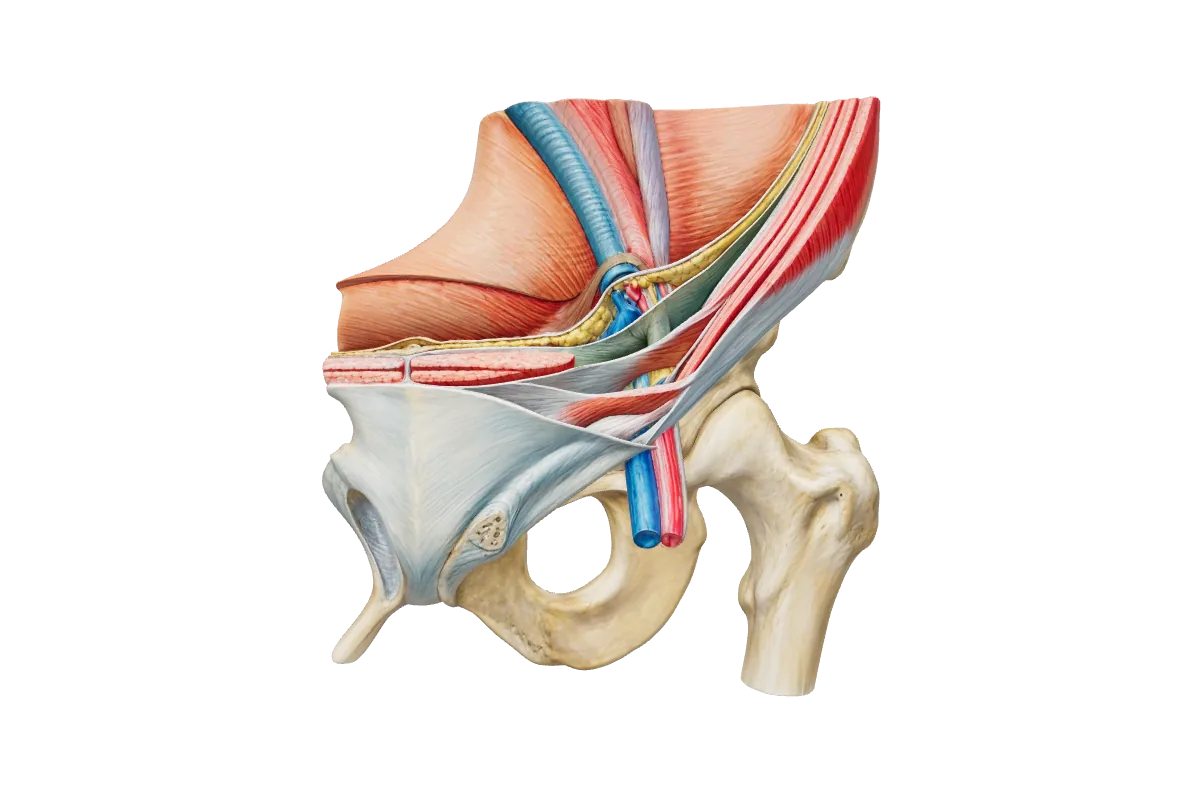
Interactive 3D: Inguinal canal & hernia anatomy

Drag to rotate, tap the hotspots, press play.

Inguinal canal & hernia anatomy — still render

Also in this domain: Calot's triangle & the biliary tree (coming soon), Circle of Willis (coming soon), Axilla & breast lymphatics (coming soon)

Free revision notes

Surgical conditions questions, answered

How many questions on surgical conditions are in Paper 2?

The ICBSE blueprint lists 45 of the 120 Paper 2 questions under common congenital and acquired surgical conditions, split across twelve specialty lines from gastrointestinal disease (7) and orthopaedics (7) down to lymphoreticular disease and acute emergencies (2 each). With physiology it is the joint largest line of the whole exam.

What is triple assessment of a breast lump?

Clinical examination, imaging and needle biopsy, ideally at one visit: ultrasound for women under 40 and mammography with ultrasound from 40, and core biopsy rather than fine-needle aspiration so that invasion, grade and receptor status can be reported. Each component is scored (P, M or U, and B1–B5) and the results are reconciled in the multidisciplinary meeting.

Which suspected-cancer referral criteria are most often tested?

Those in NICE NG12 for the common surgical cancers: an unexplained breast lump at 30 or over; visible haematuria at 45 or over without infection; and for colorectal cancer the combination of age, rectal bleeding, change in bowel habit, iron-deficiency anaemia and a positive faecal immunochemical test. Questions ask whether a patient meets the criteria for a two-week-wait referral.

Which classifications should I know for this line?

The ones that change management: Hinchey for diverticulitis, Fontaine or Rutherford for chronic limb ischaemia and the Rutherford categories for acute ischaemia, CEAP for venous disease, the U and Thy grades for thyroid nodules, Glasgow–Blatchford and Rockall for upper GI bleeding, and the WHO performance status for cancer treatment decisions.

Drill surgical conditions tonight

Create a free account, filter the bank to this domain and rate your confidence as you go. Upgrade when you want the full bank and two-paper mocks.