A 58-year-old woman falls onto her shoulder from a stepladder. Her anteroposterior shoulder radiograph is shown.
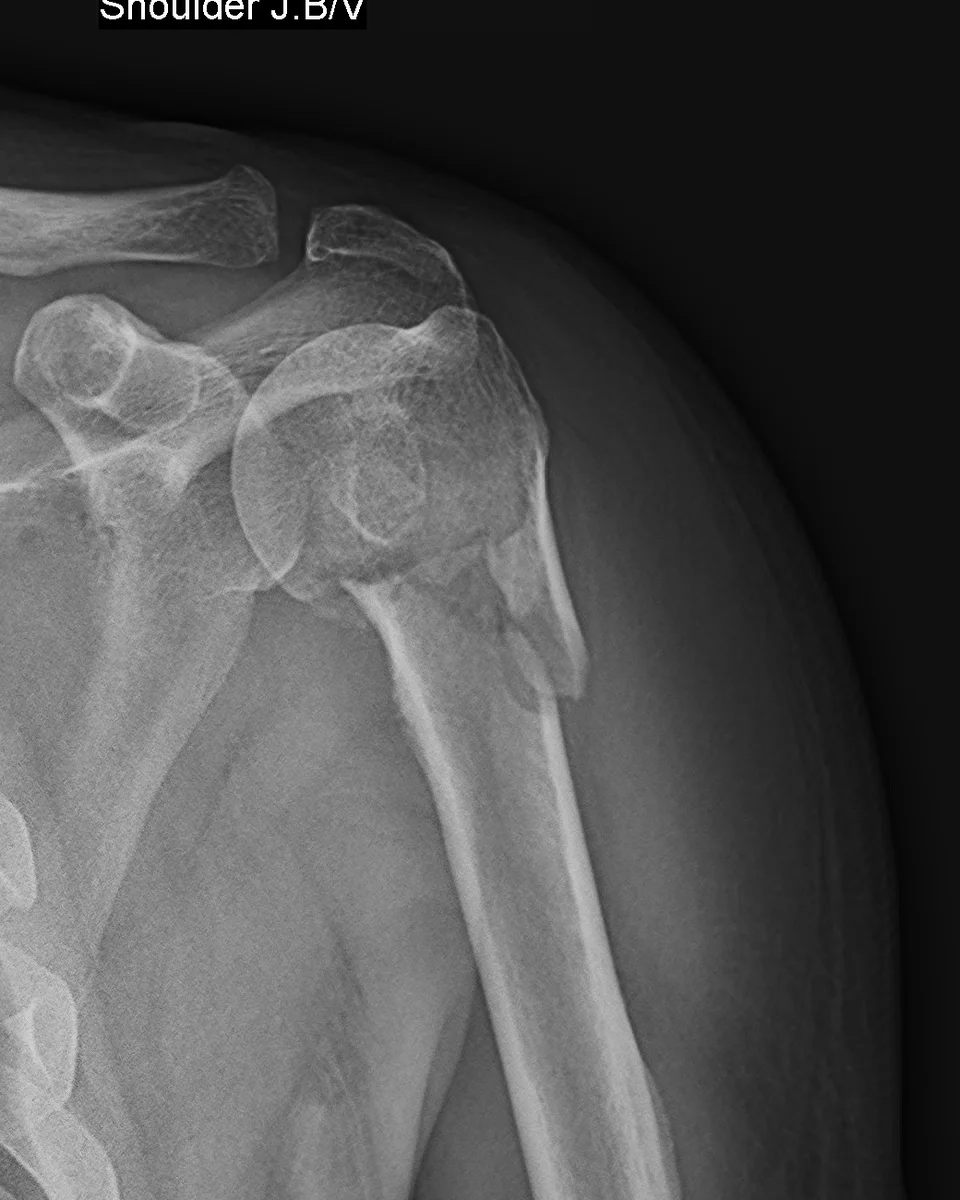
Which muscle is chiefly responsible for the position of the humeral shaft relative to the head?
How sure are you?
Free practice question 1 of 50 · Upper limb & breast
An original single best answer question in the style of the MRCS Part A paper, with the answer and a referenced explanation. Pick an answer to reveal it, then rate how sure you were.
A 58-year-old woman falls onto her shoulder from a stepladder. Her anteroposterior shoulder radiograph is shown.
Which muscle is chiefly responsible for the position of the humeral shaft relative to the head?
Topic guide
Upper limb & breast: what the exam tests
Syllabus coverage, high-yield themes and the common traps.
Free article
Brachial plexus anatomy: roots to branches, and the nerve lesions that follow
Brachial plexus for MRCS Part A with a 3D model: roots, trunks, divisions, cords and branches, Erb's and Klumpke's palsies and the classic nerve lesions.
Free article
The axilla and breast lymphatics: walls, contents, node levels and the nerves at risk
Axilla anatomy for MRCS Part A: walls and contents, the three parts of the axillary artery, node groups and levels, breast lymph drainage and nerves at risk.
Free article
Carpal tunnel and wrist anatomy: the flexor retinaculum, nine tendons, six compartments and the snuffbox
Wrist anatomy for MRCS Part A with a 3D cross-section: flexor retinaculum, carpal tunnel contents, Guyon's canal, the six extensor compartments and snuffbox.
Interactive 3D
Shoulder & rotator cuff
The right shoulder from behind: the scapula, clavicle and humerus with the four rotator cuff muscles. Supraspinatus lies above the spine of the scapula, infraspinatus and teres minor below it, and subscapularis on the front, each with its tendon on the greater or lesser tuberosity.
Interactive 3D
Scapula
A real right scapula: the acromion and the spine, the coracoid process, the glenoid cavity, the medial and lateral borders and inferior angle, and the supraspinous, infraspinous and subscapular fossae.
Create a free account with Google, Microsoft or your email and go straight into the sample bank, today's Daily Five and your readiness dashboard. No card required.