Lower limb · Interactive 3D
Gluteal region
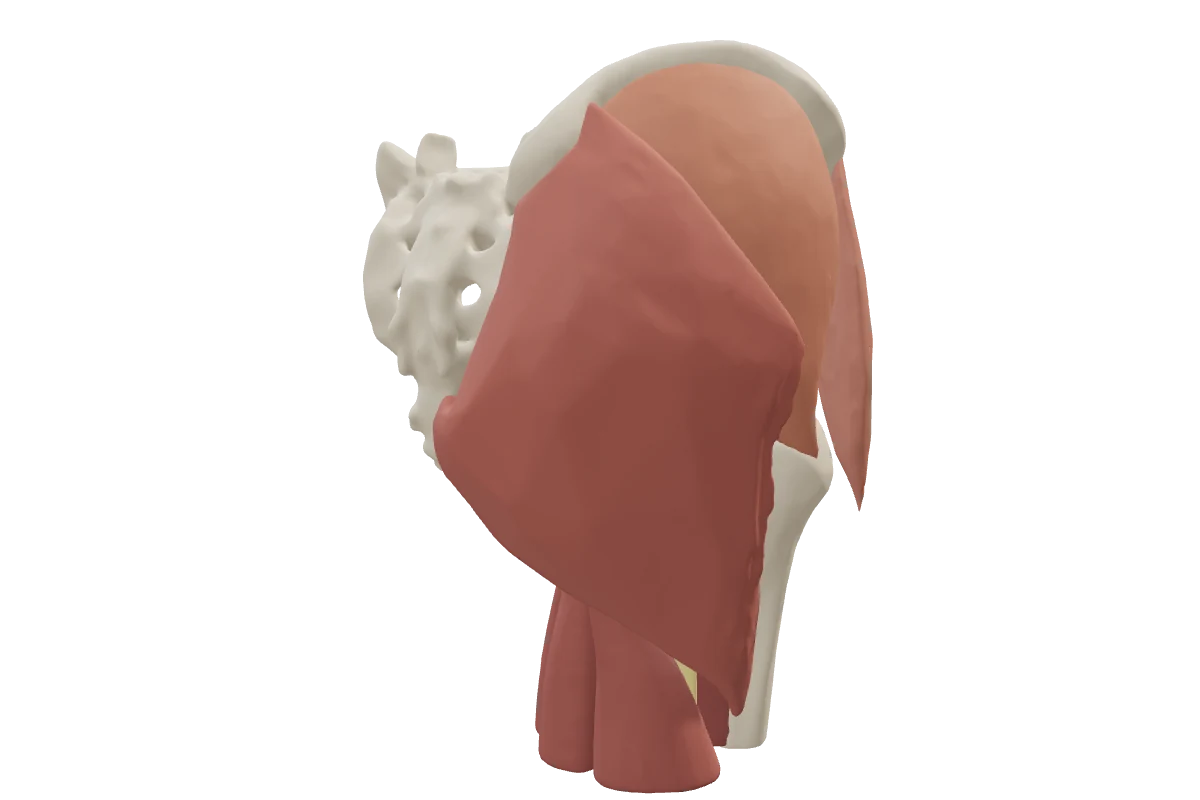
The right hip from behind, built from BodyParts3D: gluteus maximus over the deep muscles, then the layer beneath it — gluteus medius and minimus, piriformis, the short external rotators and quadratus femoris, with the sciatic and superior gluteal nerves.
Step 1 · Gluteus maximus
Gluteus maximus over the deep muscles
The right hip from behind with gluteus maximus in place, gluteus medius above it and tensor fasciae latae in front. Press play to swing maximus back on its origin from the sacrum and ilium, like a door, and see the muscles beneath.
- Gluteus maximus arises from the back of the ilium, the sacrum and coccyx and the sacrotuberous ligament, and inserts into the iliotibial tract and the gluteal tuberosity of the femur. It is the main extensor of the hip — climbing stairs, rising from a chair — supplied by the inferior gluteal nerve (L5–S2).
- In the posterior approach to the hip its fibres are split in line, not divided, and the short external rotators beneath are then taken down.
- Intramuscular injections go into the upper outer quadrant of the buttock (into gluteus medius) or the ventrogluteal site, away from the sciatic nerve.
Hotspots in this step
- 1Gluteus maximus — The largest muscle in the body: the main extensor and a lateral rotator of the hip, supplied by the inferior gluteal nerve (L5–S2). Weakness gives a backward lurch of the trunk at heel strike.
- 2Gluteus medius — From the outer ilium below the iliac crest to the greater trochanter. The main abductor, holding the pelvis level in single-leg stance; superior gluteal nerve (L4–S1).
- 3Tensor fasciae latae — From the front of the iliac crest into the iliotibial tract; superior gluteal nerve. The interval between it and sartorius is the direct anterior approach to the hip.
- 4Iliac crest — Its highest points lie level with the L4 spinous process (Tuffier's line), the landmark for lumbar puncture.
- 5Sacrum — Gluteus maximus arises in part from its back; piriformis arises from its front.
- 6Greater trochanter — Gluteus medius and minimus insert on it, and the short external rotators round its back and into the trochanteric fossa. Pain over it (greater trochanteric pain syndrome) is usually gluteal tendinopathy rather than bursitis.
- 7Long head of biceps femoris — One of the hamstrings, with semitendinosus and semimembranosus. They arise from the ischial tuberosity under the lower edge of gluteus maximus; a complete proximal avulsion with retraction is usually repaired early.
Built from BodyParts3D (© The Database Center for Life Science, CC BY 4.0), with changes: each part re-surfaced and smoothed and the thigh cut at mid-shaft; the sciatic and superior gluteal nerves, which the data set lacks, drawn by hand in their usual course. The gluteal vessels and the sacrotuberous and sacrospinous ligaments are not shown. Specialist review pending.
Embed this model on your siteFree for teaching
Free to use on teaching pages, deanery and society sites and blogs. Paste this code where you want the model; please keep the credit line.
More models
Brachial plexus
The brachial plexus from roots to terminal branches: C5–T1 roots, the upper, middle and lower trunks, anterior and posterior divisions, the lateral, posterior and medial cords, and the nerves each gives off.
Open modelWrist cross-section
A transverse section through the distal forearm just above the wrist: radius and ulna, pronator quadratus, the flexor tendons and median nerve on the palmar side and the extensor compartments dorsally.
Open modelInguinal canal & hernia anatomy
The left groin from the front with the abdominal wall opened in layers: the deep inguinal ring, the inguinal ligament with the femoral artery and vein passing beneath it into the thigh, the femoral canal medial to the vein, and the hip bone and femur for orientation.
Open modelTest yourself
Free MRCS Part A questions on lower limb
Lower limb questions for MRCS Part A · 50 free MRCS Part A questions with answers · The full MRCS Part A question bank (3,041 SBAs)
Start with 20 free questions
Create a free account with Google, Microsoft or your email and go straight into the sample bank, today's Daily Five and your readiness dashboard. No card required.